Translucent colours
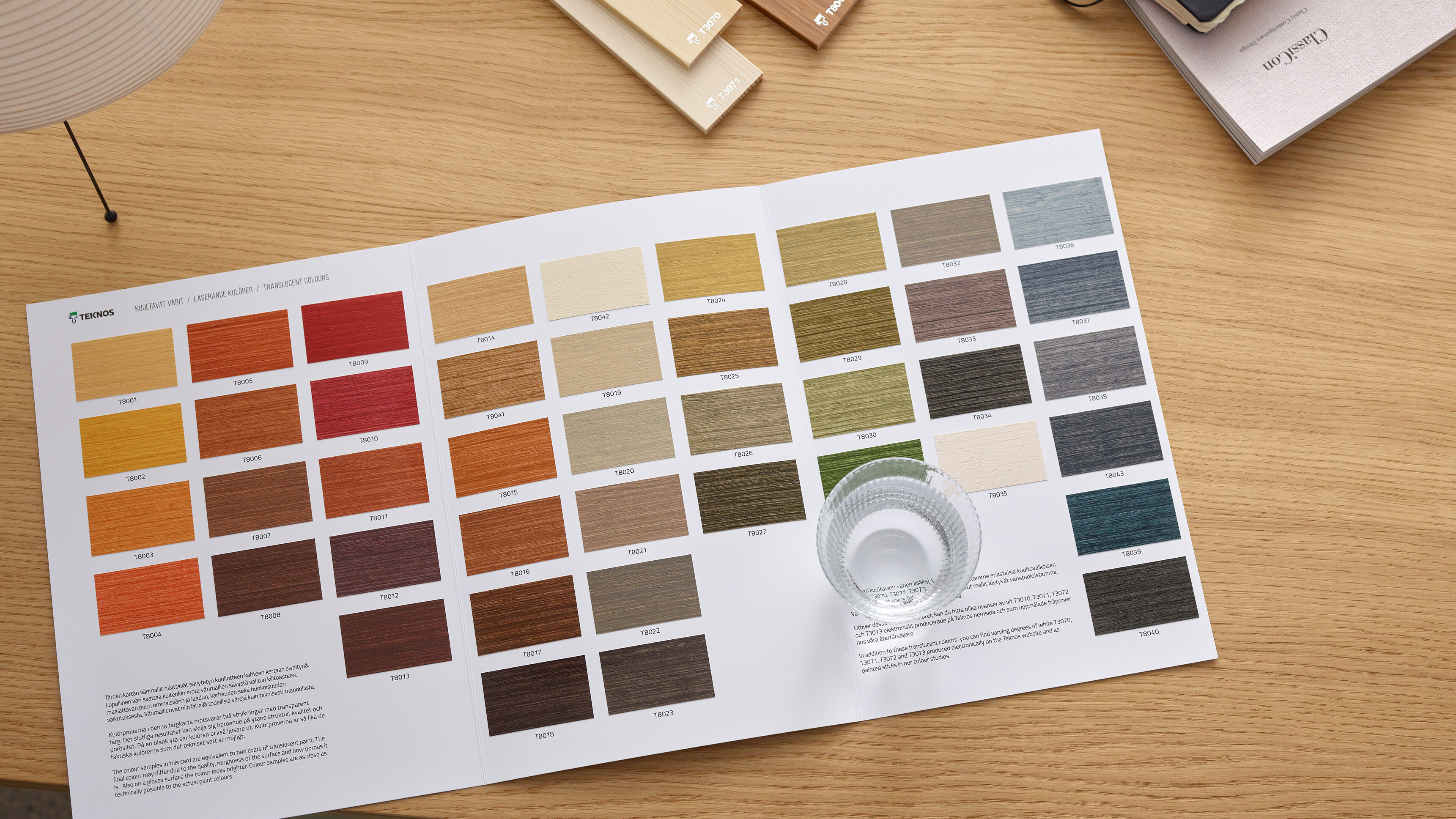
Browse the colour chart of our translucent colours for wooden interior and exterior surfaces.

Teknos’ translucent colours highlight the natural beauty of wood and allow the grain to remain beautifully visible. However, choosing the right translucent shade can feel challenging, as the natural colour of the wood has a significant impact on the final appearance. Explore the key things to consider when selecting a translucent shade—our experts’ tips will make the process easier and help ensure you remain happy with your choice for years to come.
Exterior wood surfaces should be protected to ensure they last as long as possible. Sunlight breaks down the surface of the wood, and wood also greys and fibres rise quickly. Log surfaces, in particular, require highly breathable coatings. Coating needs to be chosen according to purpose. They protect wood surfaces from moisture and dirt and, when tinted, also from the sun’s UV radiation. The colour itself therefore plays an important protective role.
Local building regulations and the architecture of your home may influence the choice of exterior colour. Otherwise, the colour should primarily be selected according to your own preferences. You can choose a harmonious shade to blend your building into its surroundings, or use stronger contrasts to make it stand out. Light-coloured buildings are more prominent in the landscape and are visible from further away than dark-coloured ones.
Note: A painted façade appears lighter and more saturated from a distance than the colour sample on the chart. In addition to the surrounding landscape and nearby buildings, the season, time of day and weather conditions also affect how the colour is perceived.
On planed, smooth surfaces, colours appear lighter than on rougher, fine-sawn surfaces. Different wood species also vary in tone.
The number of coats affects how strongly the colour shows. For new, primed wood, the recommended application is 1–2 coats of tinted translucent finish.
Different painters naturally have different application styles. The amount of translucent stain/oil/varnish applied can vary significantly between individuals, which also affects the final outcome. If the upper and lower parts of a wall are treated by different people, the difference is often visible. For the most even and consistent finish, both the test application and final coating should ideally be done by the same person.
We always recommend carrying out a test application on the same type of wood to ensure the shade is exactly what you wish!
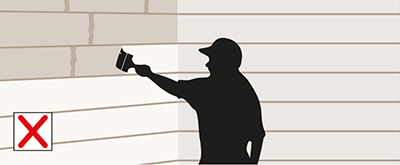
Tip! How to avoid visible lap marks:
Always treat one board or log at a time, working continuously from end to end, and finish with a light levelling stroke in the direction of application.
Our translucent white shades (T3070–T3073) differ in how much white tinting paste is added to the product. Each step increases the level of whiteness while still allowing the natural structure of the wood to remain visible.
Note that the finish on a light, fresh wood is totally different compared to aged, yellowed wood.
Many people want their new wood surface to have the look of naturally weathered grey wood. This can be challenging, as new, healthy wood has a yellowish tone that affects the final colour.
In our TRANSLUCENT COLOURS chart, the warm grey shades are T8020, T8021 and T8022, while T8032 is a slightly cooler grey.
Naturally weathered wood is often browner than we imagine, so warmer grey tones usually work better when you want that beautiful, weathered wood appearance.